Safety Culture or Corporate Compliance?
Safety meetings, endless policies, and monitoring cameras mandate strict safety compliance, but dispatch pressure and unpaid pre-trips force drivers to cut corners. Is trucking truly operating safely, or just building a corporate liability shield?

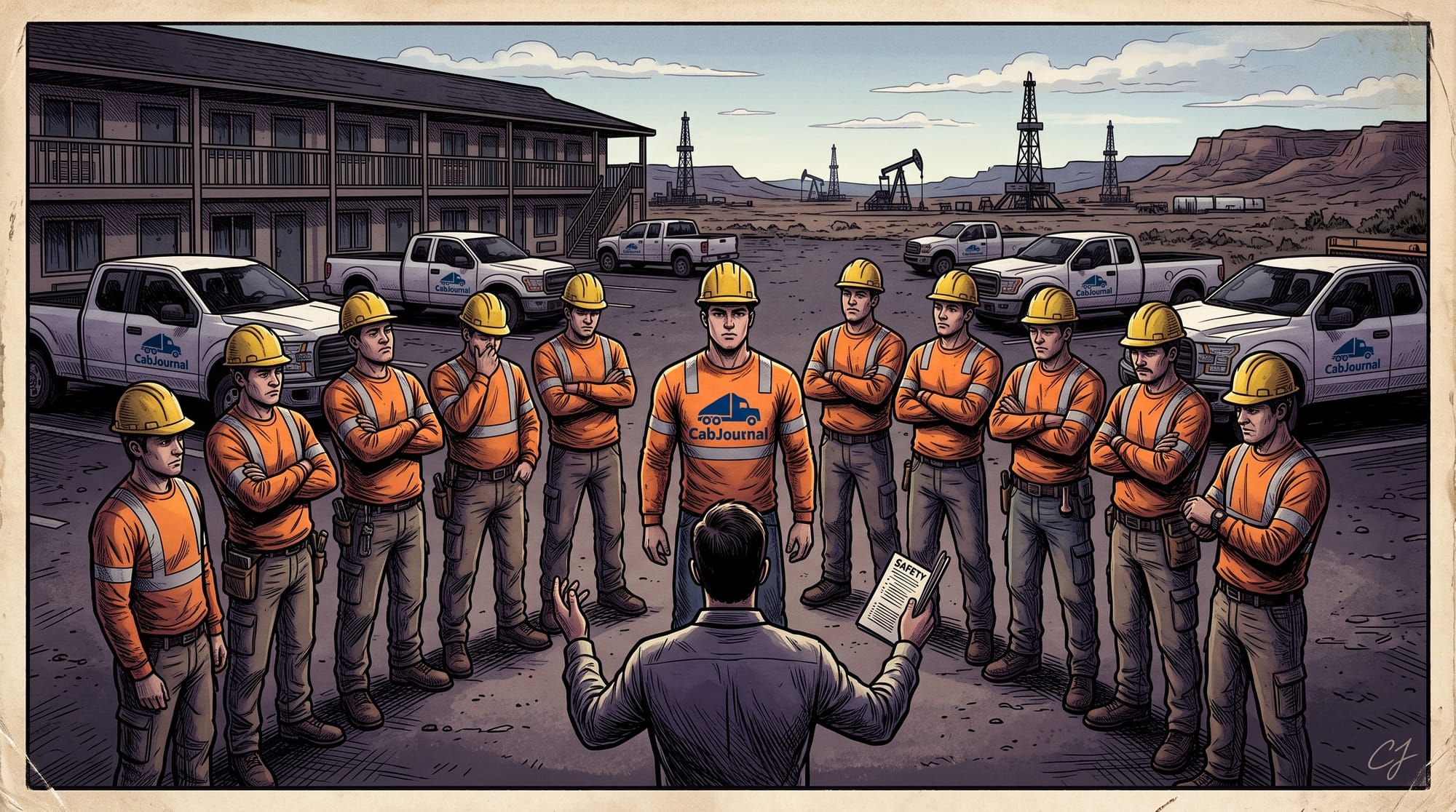
In 2012, I was working in Parachute, Colorado, for an oil exploration company, contracted under Kinder Morgan. Our crew was staying at a hotel, and every morning we would have our safety meeting in the parking lot. Kinder Morgan had a strict policy that we referred to as the “blue sky rule.” It meant that we had to wear our PPE (Personal Protective Equipment), hardhat, safety glasses, high visibility shirt, gloves, pants, and boots to the safety meeting every day, even though there were no hazards in the parking lot of the hotel. In addition to the “blue sky rule,” we were required every day to fill out a JHA (Job Hazard Analysis) card, identifying a hazard spotted in the field. That could be a loose rock, a downed fence, anything that could lead to an injury.
At the time I remember thinking that the “blue sky rule” was annoying and ridiculous – it was stupid! Wearing a hardhat at a hotel made no sense, and how was filling out a daily safety card keeping me safer? But over the years, having seen many workplace accidents in the oilfield, and more recently in the trucking industry, I began to understand why. Kinder Morgan was building a safety culture; they were practicing what they preached, beginning and ending in that hotel parking lot.
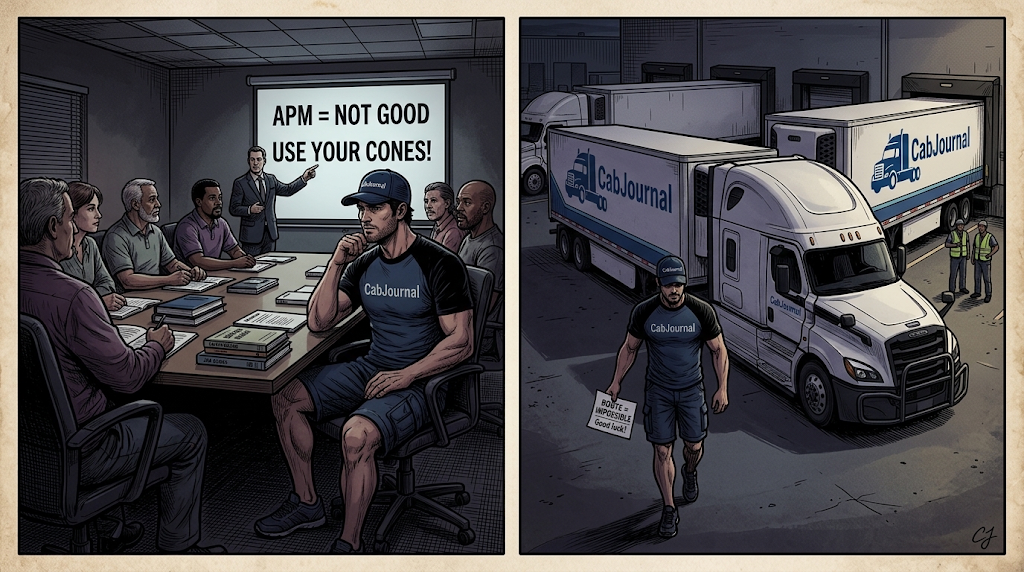
In the trucking industry today, safety is everywhere. Stickers all over the sides of trucks and trailers, G.O.A.L. (Get Out And Look)! AI-powered cameras monitoring our every move, reporting bad behaviors back to management. Lane-departure alerts and automatic hazard braking built right into the trucks. Endless safety videos, completed on our own time, throughout the year. Mandatory safety meetings where accidents and “best practices” are discussed. “Drivers, use your cones!”
We hear about the importance of pre-trips, G.O.A.L., and safety every single day, but is there a real safety culture in the trucking industry, or is it just compliance?
Imagine you’re a truck driver and you just picked up a new job for a large distributor. During orientation week, the focus is entirely on safety: safety in the warehouse, safety in the parking lot, and safety on the road. You’re impressed. This company seems to care A LOT about safety. And safety didn’t end after orientation. Now you learn the ins and outs of the job with a certified safety trainer who sits in the passenger seat of your truck for weeks, making sure you are well-equipped to perform your job safely.
But nearing the end of training, doubts have already been creeping into your mind. You could often see the frustration on the instructor’s face, as there just didn’t seem to be enough time in the day to finish the route. Despite this, you’re still excited to be done and ready to start your own routes. Things will certainly improve, right? As you get faster and more efficient, you notice that your route sizes also increase. It’s becoming increasingly common to be scheduled for 14 hours, the maximum amount allowed by law. Now you face a dilemma: wanting to get home to your family, you begin cutting corners. Ten-minute pre-trip? Let’s make that three. Everyone else is doing it. Fuel up at the end of the day? Not enough time. G.O.A.L.? Not a chance, 15 minutes left on your clock.
There are two opposing messages that a truck driver hears on a daily basis. The voice from management says: “Drivers, you need to slow down out there, we’ve seen an uptick in accidents lately!” “We’ve spent $30,000 on service calls this quarter alone!” “Make sure you are performing a proper pre-trip!” “Use your cones!” Then there’s the message that drivers hear from dispatch. “We had a driver call-in this morning so we combined your routes.” “Customers are waiting!” “The other driver can do it, why can’t you?” “That defect isn’t that serious, we will fix it tomorrow.”
But why are there two separate, distinct messages within the same company? The message that a driver receives from management is a corporate liability shield – it’s designed to establish a paper trail that can be used in the event of a lawsuit. The company needs to prove that their employee was acting within the scope of their employment at the time of the accident, in order to dismiss negligence claims. This isn’t a bad thing; proper training, hiring, and supervisory practices are important to operating a safe motor carrier. Where it breaks down, however, is when those policies aren’t consistent with the actual workplace environment. Dispatch is under an immense amount of pressure to get the job done, and that, of course, is where the safety mindset collapses.
These opposing messages translate into real-world statistics. According to FMCSA data, one in five DOT roadside inspections result in a vehicle being placed out of service. That’s right, one out of every five semi trucks you see should not be driving down the road.
But not every carrier shares the same concerning OOS (Out Of Service) statistic. Companies like Walmart boast just a 3.4% OOS rate. Why’s that? Walmart pays their drivers for every moment they are on the clock. In 1938, the Fair Labor Standards Act was signed into law, giving American laborers workplace rights. However, within that law was a carve-out, the Motor Carrier Exemption, which excludes interstate truck drivers from these same rights such as overtime and detention pay. Walmart pays drivers for every second they’re on the clock. Drivers don’t skip the pre-trip because they are paid to do it. Most carriers do not pay for pre- or post-trip inspections, giving drivers no financial benefit to perform them.
In fact, most financial pay structures for drivers are performance-based. CPM (Cents Per Mile) is the standard in the interstate driver industry, and because of the Motor Carrier Exemption, it’s standard practice for carriers to withhold detention pay, or institute rules regarding when or if that pay will be applied. Waiting to be unloaded? Unpaid. Inspection? Unpaid. Paperwork? Unpaid.
Mega-carriers boast a whopping 94% turnover rate, known as churn. For every 100 new hires, 94 drivers leave within that same year. Walmart, on the other hand, has a churn rate of around 10%. Imagine trying to foster a safety culture when your employees are leaving as fast as you can hire them. Those employees have no incentive to care. There’s no workplace pride; after all, the next company is right around the corner. Read more about churn in my article: TRAPped: the OTR Churn.
The trucking industry in general has a false safety culture. There are rules on paper, there are policies, there are endless safety meetings and messages, but there is no culture. Drivers are under immense pressure from their ELDs (Electronic Logging Devices) and dispatch, to meet nearly impossible deadlines. Left with no choice, drivers are forced to cut corners, short pre-trips, and ignore policies. Dangerous, rushed driving habits are cultivated within the same company that preaches safety.
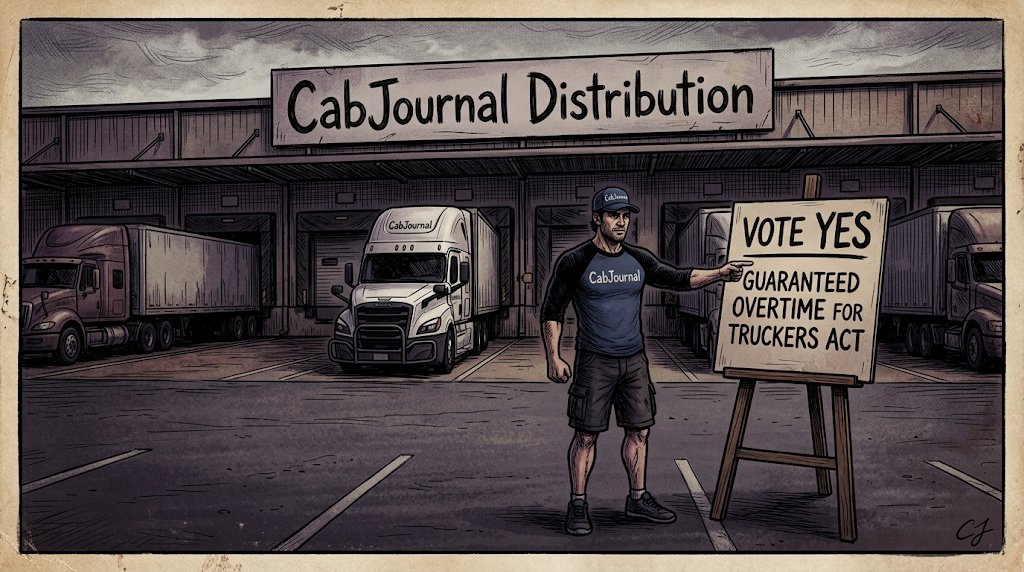
So how do we bring the “blue sky rule” to the trucking industry? The easy answer is to repeal the MCE by supporting the GOT (Guaranteed Overtime for Truckers Act), but assuming that solution isn't right around the corner, then what?
Pay for inspection time. Create an incentive for drivers to perform a proper pre-trip by paying them for their time to do so. Safety on the road begins at the warehouse. Pre-trips are crucial to keep drivers and the public safe.
Practice what you preach. Safety shouldn’t begin and end in the safety office. Those policies and procedures need to be echoed by the dispatch office. Right now, drivers are faced with conflicting messages, suggesting to them that these policies and procedures aren’t really expected of them.
Cap routes at 10 to 11 hours. When a driver sees that dispatch sheet in the morning, routing them for 14 hours, they are under intense pressure before the day even begins. Drivers are more prone to make errors, drive unsafely, skip pre-trips, and get into accidents when the pressure of the job overshadows the safety mindset.
Daily JHA (Job Hazard Analysis) cards with cash incentives. In the morning meeting in that hotel parking lot, our supervisor would pick one of these cards as a safety topic, and give a cash bonus to the person who filled it out. This can be used in the trucking industry to promote not only following policy, but to actively look for those hazards on the road.
Bring the “blue sky rule” to trucking – transform the industry from safety in name only to a real safety culture. Safety shouldn’t get thrown out the window as soon as the driver leaves the office; it needs to be the first and last thing every driver thinks about, from the moment a driver clocks in to the moment they clock out.