Reptiles in the Courtroom
Explore how plaintiff attorneys use Reptile Theory tactics and ELD data in commercial trucking lawsuits to secure multi-million dollar nuclear verdicts.

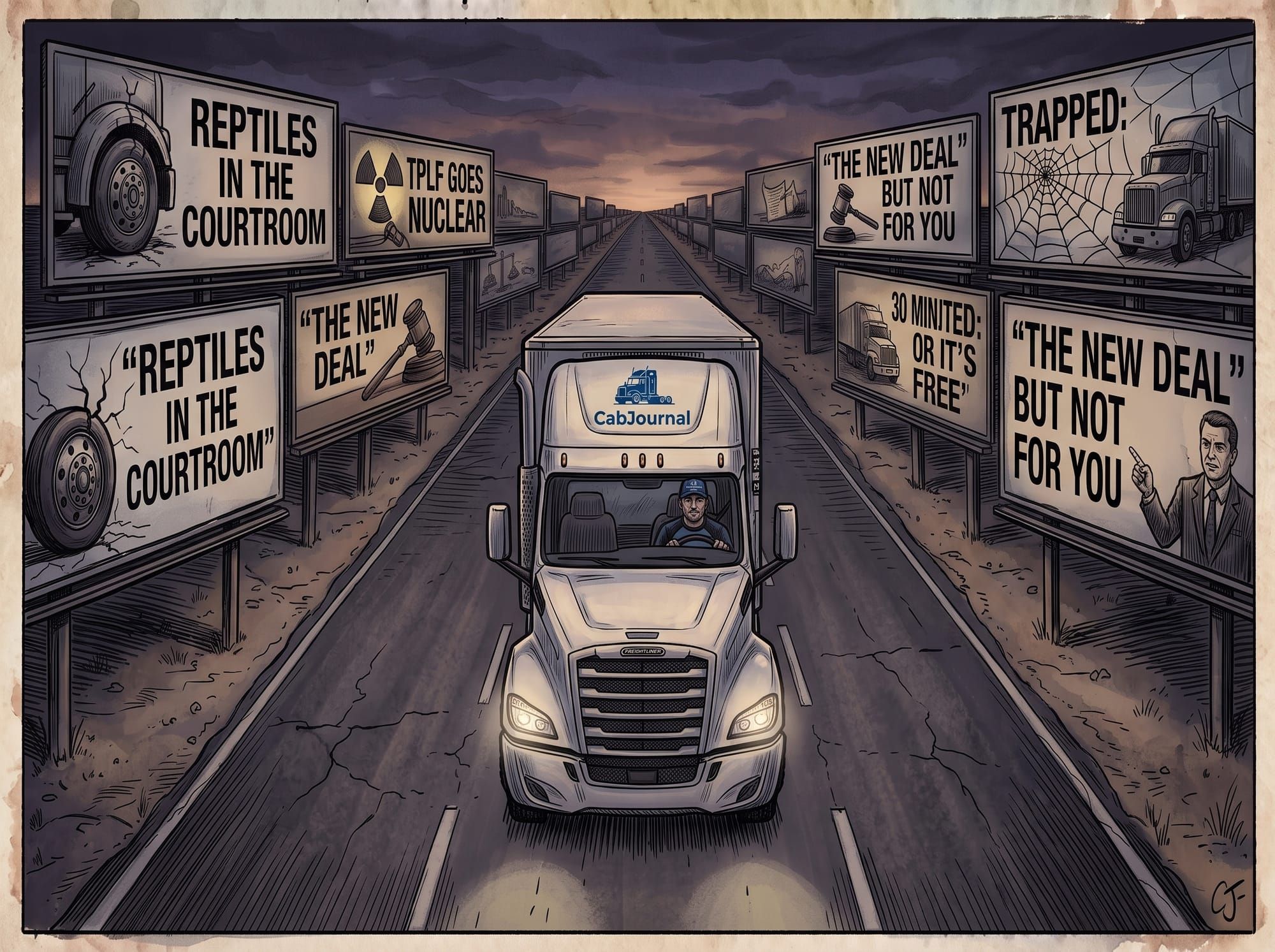
Driving through any major city, you’ll immediately notice one thing: billboards everywhere, one after another, boasting massive settlements involving truck accidents. As a commercial driver myself, seeing these billboards gives me a feeling of inevitability. Why is this such a common sight to see in our industry? What happens if I end up in the deposition room? To answer that, we first have to look at how the day-to-day job has changed.
The first thing you notice stepping into the cab of a modern-day semi-truck is the technology. A display shows how many hours you have left to work, to drive, and when you need to take your next break. This is called an ELD (Electronic Logging Device), and it does more than just track your time. In the background, it records your speed, your braking, your acceleration, and your cornering. There’s not much room for speculation: if you did it, it records it.
The second thing you will notice is the camera mounted on the windshield. It faces you and the road, and watches everything you do. The modern-day camera isn’t just a camera, it’s an AI-driven tattletale. It monitors you for “bad behaviors.” Reach for the radio too often? It yells at you: “Distracted! Distracted!” Yawning or droopy-eyed? “Take a break!” Speeding? “Reduce speed!” You get the point. It can be annoying, but the idea behind it is to stop bad behaviors before they lead to an accident.
These devices capture everything, and in the event of an accident, they can be your best friend or your worst enemy.
Imagine this:
You’re driving down a highway in the middle of the day. A car approaches and drifts into your lane. There’s nowhere to go – taking the ditch in an 18-wheeler isn’t an option. You try to give him room, but he crashes into you head-on. You’re okay, but the other driver has minor injuries and a totaled vehicle. What a headache. You call your boss, take pictures, and wait for the police and a tow truck. Finally, you get back to the yard, but it’s not over yet – mandatory drug test. But that’s it. You didn’t do anything wrong and the camera and ELD prove it. No speeding, no distraction, no swerving, no rules broken.
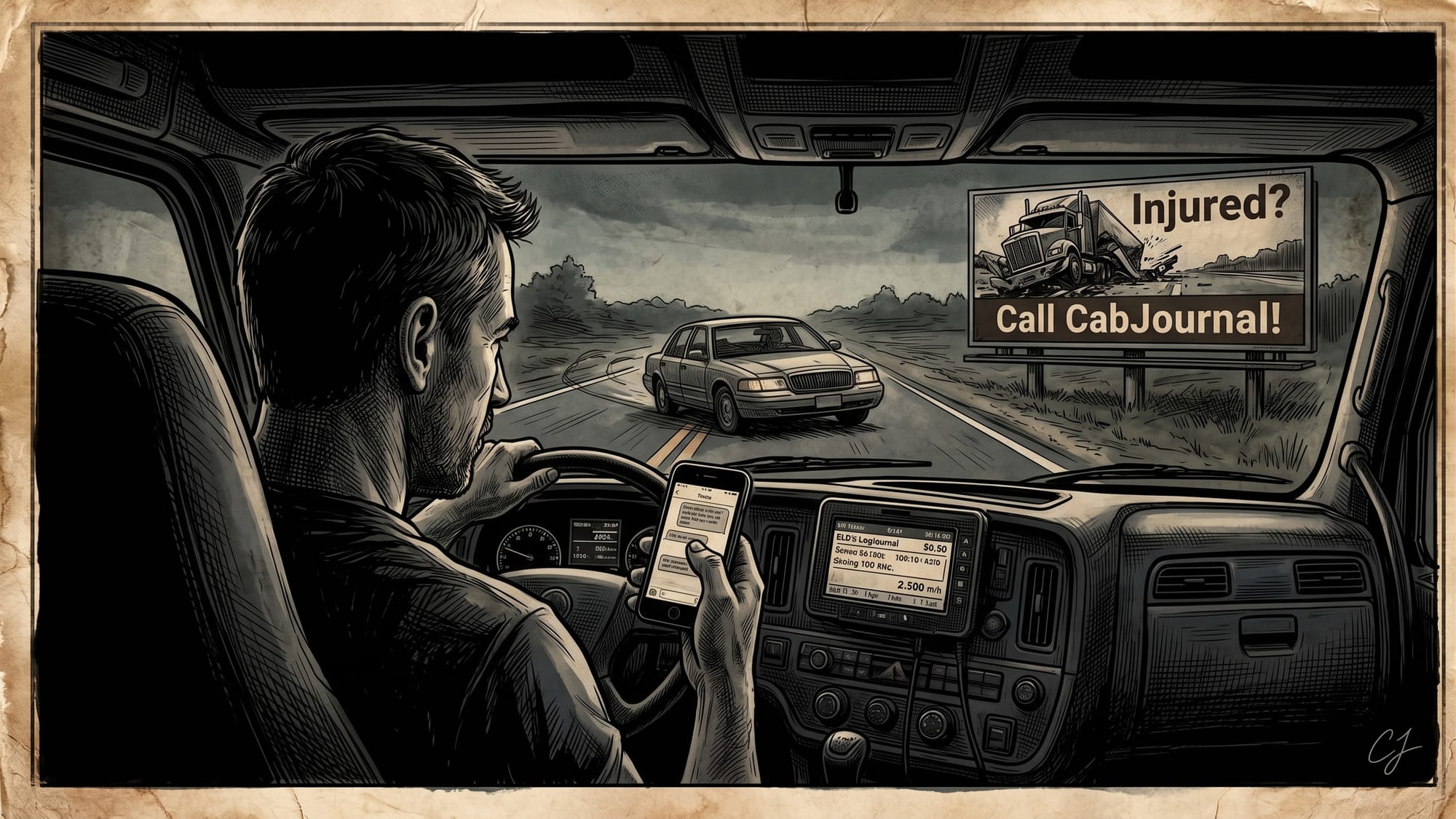
Now imagine the same scenario, except you were texting. You know you messed up, but the car drifted into your lane – you’re still not at fault, right? You get a write-up and you have to watch a couple safety videos, but you get to keep your job, a slap on the wrist. If you think that’s the end of it, you could be mistaken.
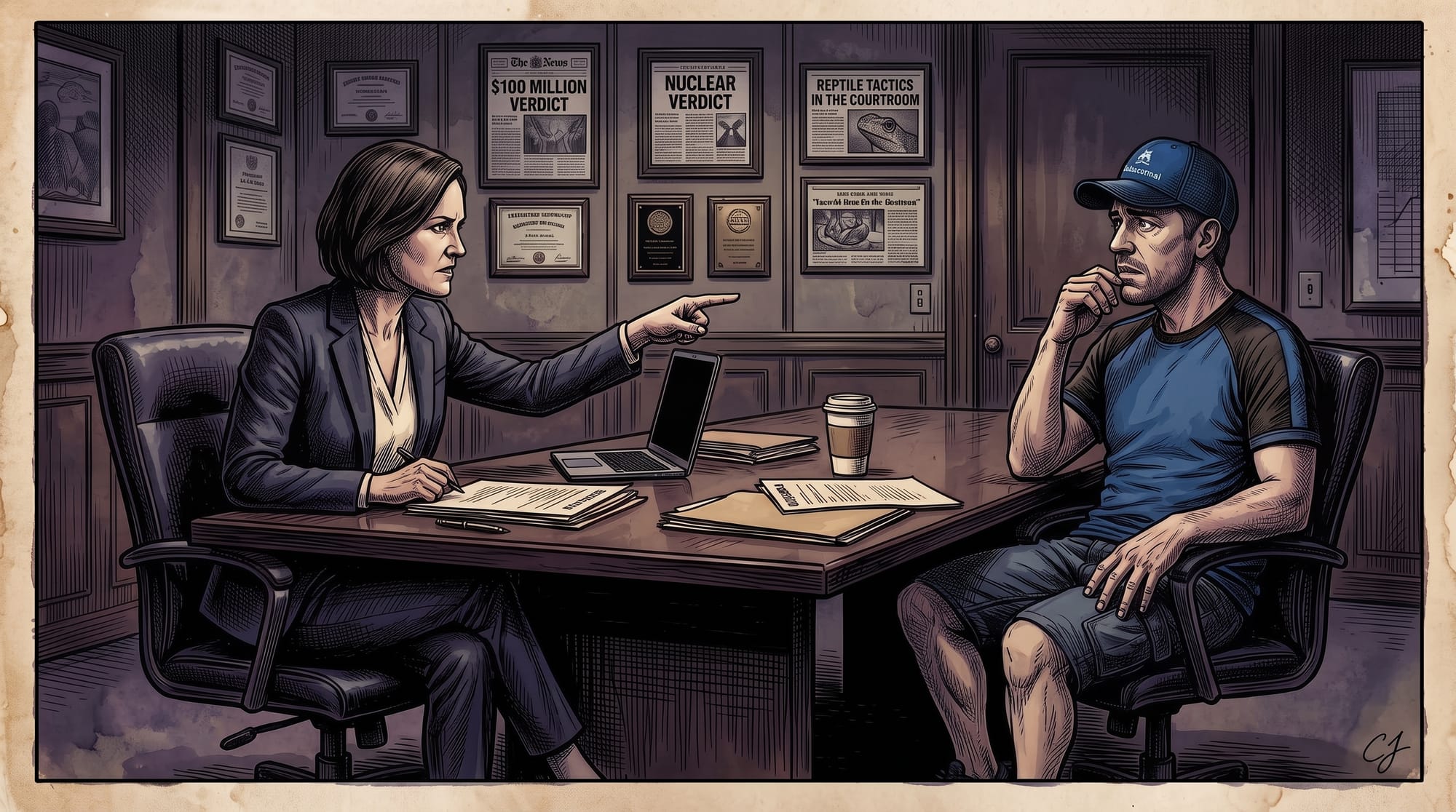
A few months go by and you find yourself in a deposition room. The plaintiff’s attorney seems nice. He tells you this is just a formality and his depositions don’t typically take too long. At first, the questions are easy – common questions like “how long have you worked for your company?” and “what time do you start your shift?” After an hour of this “short” deposition, the questions take a sharp turn:
“It was my client who crossed the center line, but is it not true that you were sending a text message at the time of the collision?”
“Is it true that this isn’t the first time you’ve driven while holding a phone in your hand?”
“Your ELD recorded you driving past your 11-hour limit on several occasions. Did management discipline you for these violations?”
“Would you agree that a commercial driver has a duty to protect the motoring public?”
The deposition room is not a place any driver would like to spend their time. The attorney has built a pattern – the repeated phone use, the violations, and a carrier that allowed this driver to stay on the road – but the real target in a lawsuit like this is not the driver – it’s the carrier, the company responsible for the driver – and it’s not long before the safety director finds himself in the same seat.
“Your company policy states that a second handheld offense requires suspension, correct?”
“Is it true that this driver had been caught operating a handheld device on three separate occasions?”
“And you are aware he was terminated from his last place of employment for distracted driving?”
“Is it fair to say that your company policy is more of a suggestion than a rule?”
“Would you agree that putting an unsafe driver behind the wheel of an 80,000-lb truck creates an unreasonable danger to the community?”
Even though the commercial driver was not responsible for the car crossing the center line, the attorney has successfully painted the carrier as a reckless corporate actor. If this case proceeded to trial, the trial lawyers would likely employ a tactic known as reptile theory.
Reptile Theory
Reptile theory is a tactic that exploits our most primitive survival instincts: fear, run, and hide. It was first introduced into the court system by Don Keenan and David Ball, who co-authored a book titled Reptile: The 2009 Manual of the Plaintiff’s Revolution. They argued that logic doesn’t win massive settlements – survival instinct does. Convince the jury that the company is a danger, and they’ll believe punishing the defendant is how they protect themselves and the community.
Werner Enterprises v. Blake
This strategy has seen huge success in trucking litigation. On December 30, 2014, Trey Salinas was driving his pickup truck with four passengers – Jennifer Blake and her children – near Odessa, Texas, in a severe winter storm. He was driving far too fast for the conditions, lost control on the icy road, crossed the median, and collided with a Werner Enterprises tractor-trailer. The crash resulted in the tragic death of a seven-year-old child and left three others severely injured.
The Werner driver, Shiraz A. Ali, was operating below the posted speed limit, but was also driving too fast for the conditions. Shiraz was also in training, and his trainer was in the sleeper cab. Despite breaking no traffic laws, the jury awarded the Blake family nearly $100 million. How does that happen? The trial lawyers used reptile theory to paint Werner Enterprises as a threat to public safety. Here’s how it worked.
Establish Absolute Safety Rules
Trial lawyers used the Texas CDL handbook to back the defense into a corner. The CDL manual states that a driver must reduce his speed to a crawl, or pull off the road entirely during icy conditions. ELD data was then used to show that the driver was traveling at an average speed of 43 mph, proving he was driving too fast on the icy roads.
Public Threat
Even though Ali was traveling under the speed limit and reacted in under two seconds to the pickup truck sliding across the median, he never should have been driving in those conditions to begin with. The legal team made the jury feel that Werner’s training and dispatch policies created reckless drivers, a threat to everyone else on the road.
Profits over Safety
The attorneys argued that Werner systematically forced inexperienced drivers into hazardous weather, prioritizing profit over human lives. They also pointed out that instead of investigating accidents with their safety department, Werner was using their legal department, painting Werner as a cold, callous, corporate entity.
Send a Message
Finally, the trial lawyers asked the jury to send a message to the entire trucking industry. The jury was persuaded that if they didn’t punish Werner with a massive verdict, their own lives and the lives of the community were in jeopardy.
The Texas Supreme Court later overturned this verdict, citing that the commercial driver's speed was not a “proximate cause” or a “substantial factor” in the crash. This case, however, still demonstrates how reptile theory can persuade a jury to award massive verdicts. Safety, negligence, imminent threat, and public duty are the psychological triggers used in court to secure “nuclear verdicts,” payouts of $10 million or more.
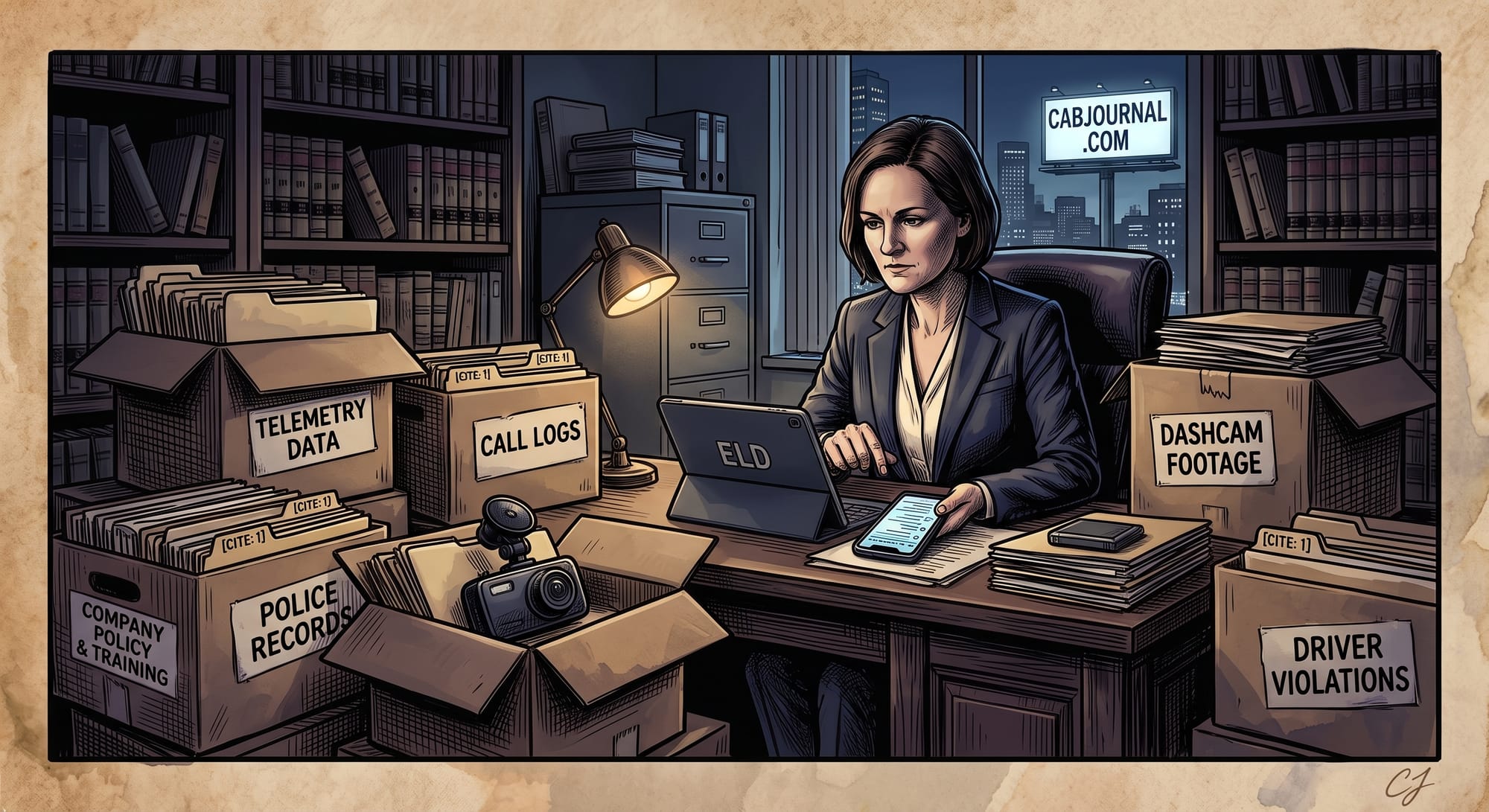
The truth of the matter is that 95% of cases are settled before they ever go to court. Still, an accident means that everything will be dissected. Attorneys can subpoena your phone, ELD, and camera, as well as the truck's telemetry data, even if you weren’t necessarily at fault, in order to find something, anything, to suggest negligence. Drivers need to realize that this is the landscape we live in, that text can wait. Carriers must be diligent in enforcing policy, training, and discipline. Those billboards aren’t going anywhere – law firms are dreaming of the day their case goes nuclear.